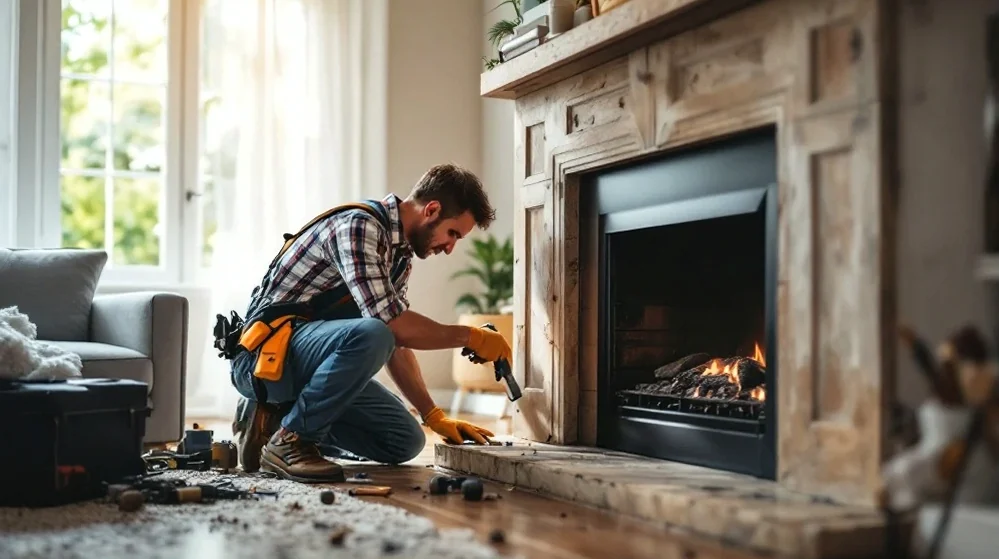
What is gas fireplace repair and how does it work?
Gas fireplace repair is the process of diagnosing why a fireplace won't light, won't stay lit, or won't heat properly, then replacing or cleaning the specific component that failed. A technician tests the ignition, gas flow, flame sensor, and venting in sequence, confirms the fault, and fixes only that part.
Most gas fireplaces in Huntsville homes are sealed combustion units or vented log sets. They run on natural gas or propane, and they rely on a small chain of parts working in order: gas valve opens, igniter sparks or glow coil heats, pilot or burner lights, flame sensor confirms heat, and the main burner stays on. Break any link in that chain and the fireplace either won't start or shuts itself off within seconds.
Repair work is mostly diagnosis, not heavy labor. A technician with a multimeter, a manometer, and a combustion analyzer can usually tell within fifteen minutes whether the problem is electrical, gas-side, or airflow-related. From there, the fix is often a single part: a thermopile, a thermocouple, a flame sensor, an igniter, or a control board.
What separates a good repair from a bad one is testing the whole system after the part swap. A new thermopile that reads correct millivolts on a cold fireplace can still fail once the unit heats up. So the fireplace gets run for ten to fifteen minutes, then re-tested. If the flame holds and the readings stay in range, the repair is done.
- Diagnosis first: identify the failed component, don't guess.
- Replace only what failed, not the whole assembly.
- Run the unit hot, then re-test to confirm the fix holds.
- Check venting and combustion air while you're in there.
Short version
- Most gas fireplace failures trace back to one part: igniter, thermopile, thermocouple, or flame sensor.
- Diagnosis is the bulk of the work, and it takes a multimeter and a manometer, not a guess.
- After the part swap, the unit gets run hot and re-tested so the fix doesn't fail on the first cold night.
- Venting and combustion air get checked on every visit because a dirty vent mimics an electrical fault.
How gas fireplace repair works, start to finish
A repair visit starts with the homeowner describing the symptom, then a technician tests the ignition sequence, gas pressure, flame sensor readings, and venting in order. Once the failed part is confirmed, it's replaced, the fireplace is run for ten to fifteen minutes, and the readings are checked again before the tech leaves.
The first thing we ask on the phone is what the fireplace does. Does it click but never light? Light and go out after thirty seconds? Light fine but put out almost no heat? Each symptom points at a different part of the chain, and knowing which one saves time on the visit.
On arrival, the tech shuts off the gas, opens the glass front, and inspects the burner, logs, and pilot assembly. Carbon buildup, spider webs, and dust are common in fireplaces that sit unused from April through October. A pilot hood packed with debris will fail to sense flame even when the pilot is lit.
Next comes the electrical side. A multimeter reads millivolt output from the thermopile or checks for 24-volt signal at the gas valve on electronic ignition units. If the reading is below spec, the thermopile or flame sensor is the culprit. If it's in range but the valve isn't opening, the valve or control board is suspect.
Gas pressure gets checked at the valve inlet and manifold with a manometer. Low inlet pressure usually means a supply issue upstream, not a fireplace problem. High manifold pressure can cause a roaring flame and soot. Both get corrected before anything else is touched.
Venting is the last major check. A blocked or partially blocked vent will cause the fireplace to shut off on its safety limit, and it can also spill combustion byproducts into the room. We inspect the termination cap, the vent run, and the intake air path. Bird nests, leaves, and insect debris are common in Huntsville because of our long warm season.
Once the fault is confirmed, the part gets replaced. Thermopiles, thermocouples, and flame sensors are usually in stock on the truck. Control boards and blowers may need to be ordered, which adds a few days. After the swap, the fireplace runs for ten to fifteen minutes with the tech watching the flame pattern, then the readings get checked again.
- Describe the symptom.Clicking but no light, lighting then quitting, or weak heat each point at a different part.
- Inspect the burner and pilot.Dust, spider webs, and carbon buildup are the most common causes of a pilot that won't sense flame.
- Test the electrical side.Millivolt output or 24-volt signal tells you whether the thermopile, flame sensor, or control board is at fault.
- Check gas pressure.Inlet and manifold pressure readings separate a fireplace problem from a supply problem.
- Inspect venting.A blocked vent shuts the unit off on safety and can spill exhaust into the room.
- Replace the failed part.Thermopiles, thermocouples, and flame sensors ride on the truck; control boards and blowers may need ordering.
- Run it hot and re-test.Ten to fifteen minutes of runtime confirms the fix holds once the unit is at temperature.
Why gas fireplace repair matters for your home
A gas fireplace that won't stay lit is usually a safety device doing its job. The flame sensor cuts the gas when it doesn't detect flame, which prevents unburned gas from collecting in the firebox. Ignoring the symptom or bypassing the sensor turns a minor repair into a serious danger.
The safety chain in a gas fireplace exists for one reason: to keep gas from flowing when there's no flame to burn it. A thermopile or flame sensor that reads low will shut the gas valve within seconds of ignition. Homeowners sometimes see this as a nuisance and ask if the sensor can be bypassed. It can't, and it shouldn't be.
A fireplace that spills combustion byproducts into the room is a different and more serious problem. This happens when the vent is blocked, the intake air path is restricted, or the fireplace is fighting a negative-pressure situation in the house. Symptoms include headaches, a lingering smell, or soot on the glass and mantel. Any of those means shut the unit off and get it looked at.
Efficiency is the quieter reason to fix a gas fireplace. A dirty burner or misadjusted air shutter produces a lazy yellow flame that throws soot and puts out less heat than the unit is rated for. A clean, correctly adjusted fireplace burns a crisp blue flame and heats the room the way it was designed to.
In Huntsville, fireplaces often sit unused from April through October. That eight-month idle stretch is when dust, spider webs, and insect nests build up inside the firebox and vent. A pre-season service in September or October catches those problems before the first cold snap, when every HVAC and fireplace company in town is booked solid.
Lazy yellow flame, soot on glass
Burner or air shutter needs cleaning and adjustment. Schedule before the heating season.
Lights then quits within a minute
Flame sensor or thermopile reading low. Safe to leave off, but book a visit soon.
Smell, headaches, or soot on the mantel
Possible venting or combustion problem. Shut the gas off at the valve and call us.
Common problems and what causes them
The five failures we see most often are a dirty or failed flame sensor, a weak thermopile, a clogged pilot assembly, a blocked vent, and a control board that won't send signal to the gas valve. Each has a distinct symptom, and each points at a specific part to test.
A fireplace that clicks but never lights usually has an ignition problem. On electronic ignition units, the igniter either isn't sparking or the spark isn't reaching the burner. On standing-pilot units, the pilot flame is too small or the thermocouple has failed. Both are quick fixes once the tech confirms which side is at fault.
When a fireplace lights and then shuts off after twenty to sixty seconds, that is almost always a flame-sensing issue. The thermopile or flame sensor isn't generating enough millivolts to hold the gas valve open, so the safety circuit closes the valve. Cleaning the sensor sometimes restores it; more often the part is worn and needs replacing.
Weak heat with a tall, lazy yellow flame points at the burner or air shutter. Dust and carbon block the burner ports, and the air shutter drifts out of adjustment over time. A cleaning and a shutter adjustment usually restores a crisp blue flame and the heat output the unit was rated for.
A fireplace that smells or leaves soot on the glass and mantel has a venting or combustion air problem. The vent termination cap may be blocked, the intake path restricted, or the house under negative pressure from a kitchen exhaust or dryer. This one gets shut off until it's diagnosed.
Control boards fail less often than the other parts, but when they do, the fireplace is completely dead: no click, no spark, no pilot. Before replacing a board, the tech confirms power is reaching it and that the safety switches are closed. Boards are the most expensive common part and the one most often misdiagnosed.
- Clicks but won't light: igniter, pilot assembly, or thermocouple.
- Lights then quits: thermopile or flame sensor reading low.
- Weak heat, yellow flame: dirty burner or misadjusted air shutter.
- Smell or soot: blocked vent or restricted combustion air.
- Completely dead: control board, power supply, or a safety switch.
Worth repairing
- Unit is under fifteen years old and parts are still available.
- Firebox, glass, and venting are in good shape.
- A single part fails, like a thermopile or flame sensor.
- You use the fireplace most winter evenings.
Consider replacing
- Control board and blower both failed on an older unit.
- Firebox has cracks or the glass is permanently clouded.
- Venting is undersized or improperly installed.
- This unit is a builder-grade model from the 1990s.
What a repair visit involves and how to prepare
Before the tech arrives, clear the hearth, move furniture back a few feet, and know the make and model of your fireplace. Have the gas shutoff valve location ready and note the exact symptom, including how long the fireplace runs before it quits. That information shortens the diagnosis.
The model plate is usually behind the lower louver or under the firebox. A photo of it saves the tech from hunting for it and helps confirm which parts fit your unit. Older fireplaces sometimes have plates that are painted over or missing, in which case the tech identifies the unit by the burner and valve layout.
If the fireplace has a remote or wall switch, test it before the visit and note whether the fireplace responds at all. A remote that's out of batteries or a wall switch that's failed will mimic a dead control board. Checking both takes two minutes and can save a service call.
Pets and kids should be kept out of the room during the visit. The tech will be working with the gas on and off, opening the glass front, and running the unit hot. A curious dog near an open firebox is a distraction nobody needs.
If the fireplace is in a tight corner or behind furniture, give the tech room to work. Most service visits take forty-five minutes to an hour and a half for a straightforward part swap. Control board replacements and venting work run longer, and parts that need ordering add a return trip.
We schedule fireplace service in Huntsville with a window, not an exact time, because diagnosis times vary. Morning appointments tend to run closer to schedule. If you're booking in October or November, call a couple of weeks ahead; that's when the calendar fills up fastest.
Book the visit before the first cold snap. A September or early October appointment gets you on the schedule without the November wait, and it catches vent and burner problems while the weather is still mild.
Need gas fireplace repair in Huntsville? Get a free estimate today.
📞 256-524-0557