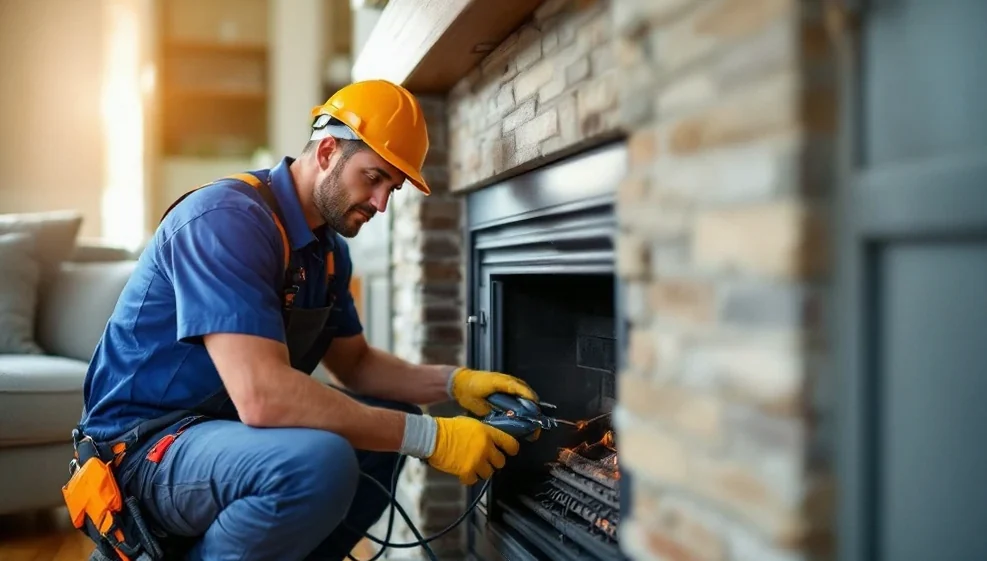
How does Gas Fireplace Repair work?
We diagnose the unit first, then fix the specific failed component, whether that's the igniter, thermocouple, gas valve, firebox liner, or venting. Most repairs are done in a single visit with parts we carry on the truck. You get a written scope and price before we start turning wrenches.
A gas fireplace is a surprisingly simple machine when you strip it down. Gas comes in through a supply line, a valve opens, an igniter sparks or a pilot keeps a small flame alive, and the burner lights. A thermocouple or thermopile sits in the flame and tells the valve it's safe to stay open. If any one of those links breaks, the whole thing stops working. That's why a fireplace that won't light is rarely a mystery once we get a meter on it.
The diagnostic step is where most of the value lives. We pull the logs and ember wool, inspect the burner ports, check the pilot assembly, test the thermopile with a multimeter, and look at the firebox liner for cracks. In Huntsville, we also look hard at the venting, because our humid summers and occasional hard freezes do a number on exterior terminations and caps. A cracked liner is one of the more common findings, and repairing it usually costs around $200. (angi.com)
Once we know what failed, the repair itself is usually straightforward. We replace the part, reseal what needs sealing, test the unit through a full heat cycle, and check for carbon monoxide at the vent. If the problem is something we can't fix safely, like a firebox with structural cracks or a vent that's routed wrong, we tell you that instead of patching it and hoping.
- Diagnostic: pull logs, inspect burner, test thermopile and valve, check liner and vent
- Scope and price: written estimate before any work begins
- Repair: replace failed component, reseal, reassemble
- Test: full heat cycle, CO check at the vent, flame appearance verification
Short version
- Most gas fireplace repairs are done in one visit, often under two hours.
- Common fixes: igniter, thermocouple/thermopile, gas valve, firebox liner, vent cap.
- A cracked firebox liner repair typically runs around $200. (angi.com)
- We always test for CO after reassembly, even on a simple part swap.
What to expect, start to finish
You call or book online, we schedule a window, and a tech arrives with a truck stocked for common repairs. We diagnose, quote, and with your go-ahead, fix it on the spot. You get a test run, a walkthrough of what we did, and a written record of the parts replaced.
The first thing we ask on the phone is what the fireplace is doing. Won't light at all? Lights and goes out after a few minutes? Smells odd? Each symptom points to a different part of the system, and knowing ahead of time means we bring the right parts. If you have the model and serial number, even better. It's usually on a metal tag behind the lower louver or under the firebox.
When we arrive, we put down a drop cloth, shut off the gas at the supply valve, and pull the logs and media. From there it's a systematic check: pilot flame quality, thermopile millivolt output, gas pressure at the valve, burner port condition, firebox liner, and venting. We use a combustion analyzer on the vent to confirm the unit is burning clean. This is the part that separates a repair from a guess.
If the fix is a part swap, we do it right there. Igniters, thermocouples, thermopiles, pilot assemblies, and most valves are things we carry. If we need a manufacturer-specific part, like a control board for a Heat & Glo or a Majestic, we order it and come back. That's usually a few days depending on the brand.
After the repair, we run the unit for at least 15 to 20 minutes. We watch the flame pattern, confirm the pilot stays lit, and check CO at the vent termination. Then we shut it down, put the logs back the way they were, and walk you through what failed and why. You get a copy of the invoice with part numbers, which matters if the unit is still under warranty.
- Call or book.Tell us the symptom and, if you have it, the model and serial number. We'll schedule a window and note likely parts.
- On-site diagnosis.We shut off gas, pull the logs, and test the pilot, thermopile, valve, burner, liner, and vent. This takes 20 to 40 minutes.
- Written scope and price.You get a clear description of the failed part and the cost to fix it before we touch anything.
- Repair.Common parts get swapped on the spot. Special-order parts mean a second visit, usually within a week.
- Test and walkthrough.We run a full heat cycle, check CO at the vent, and show you what was replaced.
How long does Gas Fireplace Repair take?
Most repairs take one to two hours on site. Diagnostic visits run 30 to 45 minutes. If a special-order part is needed, add three to seven days for shipping, then another hour for the install and test. We don't leave a unit running until it passes a CO check.
The clock starts when we pull into your driveway, not when we pick up the phone. A straightforward thermocouple or igniter swap is often under an hour. A gas valve replacement takes longer because we have to isolate the supply, remove the burner assembly, and leak-test everything on reassembly. Firebox liner repairs depend on the material and how much disassembly is needed, but most are done in a single visit.
Special-order parts are the main variable. Brands like Heat & Glo, Majestic, and Vermont Castings have different lead times, and some older units have parts that are no longer made. When that happens, we tell you up front and talk through options: aftermarket equivalents, a retrofit kit, or replacing the unit if the repair cost approaches the price of a new fireplace.
Huntsville weather can add a wrinkle. If your vent termination is on an exterior wall that gets full afternoon sun, we may schedule the vent inspection for the morning to avoid working in 95-degree heat. In winter, we see a spike in no-light calls after the first hard freeze, and our schedule fills faster. Booking early in the fall is the easiest way to avoid a wait when you want the fireplace on.
Day of call
Phone or online booking, symptom triage, and a scheduled window, usually within a few days.
Visit 1: diagnosis and common repair
30 to 45 minutes to diagnose, 1 to 2 hours total if we have the part on the truck.
If a part is ordered
3 to 7 days for shipping, depending on brand and availability. We'll call when it lands.
Visit 2: install and test
About an hour for the swap, plus 15 to 20 minutes of run time to confirm the fix.
What drives the cost of a repair
Part cost and labor access are the two biggest factors. A thermocouple is cheap and easy to reach. A gas valve or firebox liner takes more labor. A cracked liner repair typically runs around $200, but a full valve replacement can run several times that depending on the unit. (angi.com)
We quote the repair, not an hourly rate. That means the price you hear is the price you pay, assuming we don't find something else once we're inside. If we do find a second issue, we stop and re-quote before proceeding. Nobody likes surprise line items.
Access matters more than people expect. A fireplace set into a tight chase with a stone surround can take twice as long to work on as a freestanding unit with clearance on both sides. If the gas shutoff is behind a panel that's been painted shut, that's time too. We've seen plenty of Huntsville homes in neighborhoods like Blossomwood and Five Points where the original fireplace was converted to gas decades ago, and the shutoff is in a spot nobody's touched since.
A neglected chimney can end up costing the owner thousands in repair costs. (a1chimneyspecialist.com) That's the worst-case scenario, and it's why we push for an annual inspection. A $200 liner fix today beats a rebuilt firebox next year.
Cheaper repairs
- Thermocouple or thermopile replacement
- Igniter or pilot assembly swap
- Firebox liner crack repair, often around $200 (angi.com)
- Vent cap or termination screen replacement
Pricier repairs
- Gas valve replacement
- Control board or remote system failure
- Firebox rebuild or panel replacement
- Vent rerouting or liner installation
What homeowners get wrong about gas fireplace repair
The biggest mistake is waiting until the fireplace won't light at all. Small issues like a weak pilot or a hairline liner crack get worse and cost more. The second is assuming a gas fireplace needs no maintenance because it doesn't burn wood. It still has a vent, a burner, and a safety system that needs checking.
A gas fireplace that lights every time can still be running dirty. We've tested units in Huntsville where the flame looked fine but the CO reading at the vent was higher than it should be. That's usually a sign of blocked burner ports or a vent that's partially obstructed, often by a bird nest or debris in the cap. You won't smell it, and you won't see it. The only way to know is to test.
Another common one: homeowners replace the thermopile themselves, the fireplace works for a week, then quits again. That usually means the valve or the pilot assembly is what's failing, and the thermopile was a symptom, not the cause. We see this a lot with DIY parts swaps. The part wasn't the issue, so the fix doesn't hold.
People also forget that the vent termination outside needs attention. In Huntsville, that means checking it after spring pollen, after fall leaf drop, and after any ice event. A cap full of leaves restricts airflow and can cause the unit to shut down on a safety limit. It's a five-minute check that prevents a service call.
Pilot flame is weak or yellow
Usually a dirty pilot orifice or a thermopile on its way out. Not urgent, but schedule it before winter.
Fireplace lights then shuts off after a few minutes
Often a thermopile or valve issue. It will get worse, and it's a sign the safety system is doing its job.
Smell of gas or soot on the glass
Shut off the gas at the supply valve and call us. Soot means incomplete combustion, and a gas smell means a leak.
After the repair: what to watch for
Run the fireplace for a full cycle the first cold night and note anything odd: delayed ignition, a lazy flame, or a smell that isn't the usual dust burn-off. Most repairs hold for years, but a part that fails within the warranty window gets replaced at no labor cost.
New parts sometimes have a break-in smell. That's normal for the first hour or two, especially on a new pilot assembly or valve. What's not normal is a persistent sulfur or rotten-egg smell, which means gas is escaping somewhere it shouldn't. Shut it down and call us.
We warranty our labor, and most manufacturer parts carry their own warranty. If something we replaced fails within that window, we come back and make it right. Keep your invoice. It has the part numbers and the date, which is what the manufacturer will ask for.
The best habit is a quick visual check before the first fire of the season. Look at the pilot, look at the vent cap outside, and make sure nothing's blocking the air intake. If you're not comfortable doing that, that's what the annual service is for. A neglected chimney can end up costing the owner thousands in repair costs, and most of that is preventable. (a1chimneyspecialist.com)
A fireplace that lights every time can still be running dirty. The only way to know is to test the vent.
Sources
Need gas fireplace repair in Huntsville? Get a free estimate today.
📞 256-524-0557